Understanding Your Emotions: A Guide to the Feelings Wheel
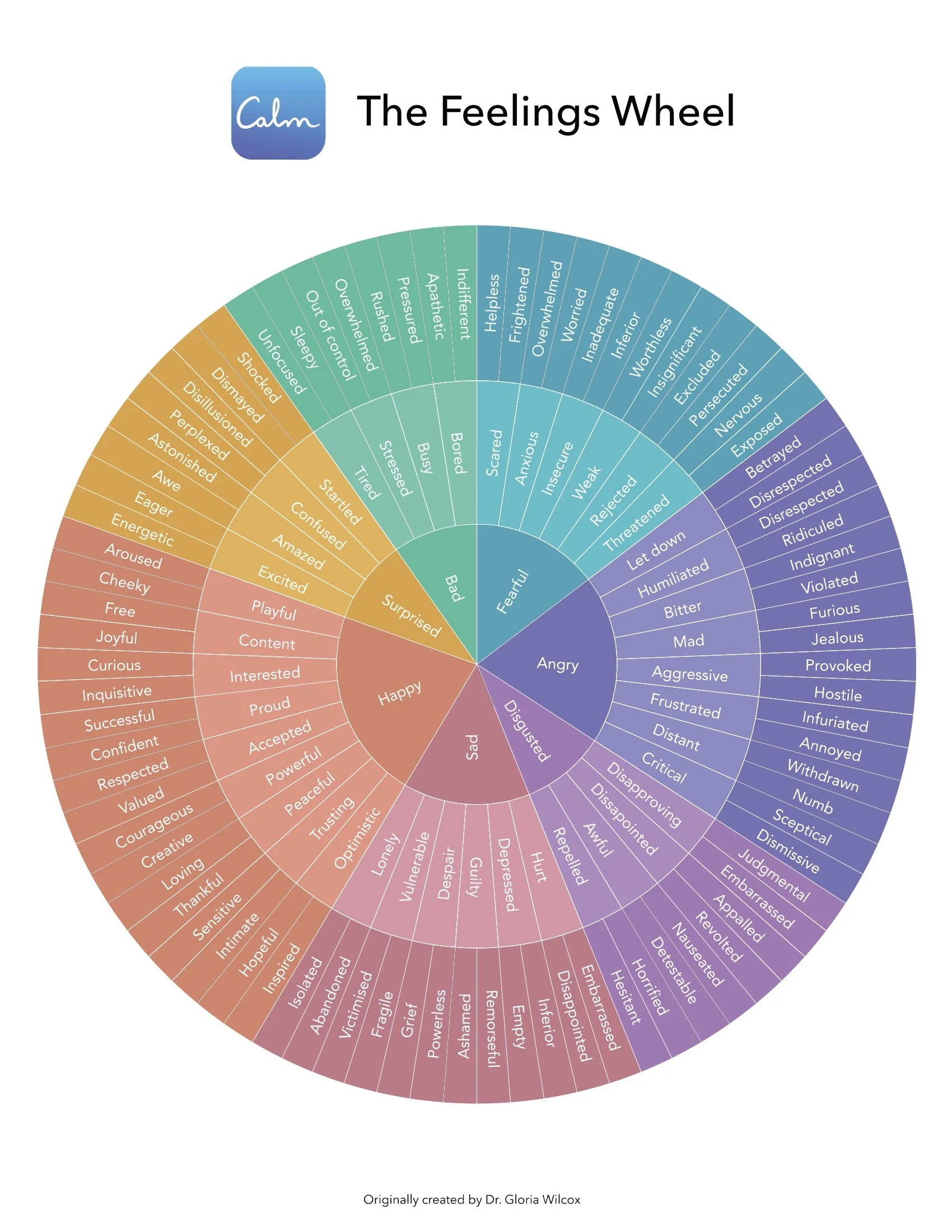
Struggling to describe exactly how you feel? You’re not alone. This is something none of us were taught in school, but sure would have been more helpful than the Pythagorean Theorem!
There's a surprisingly helpful tool that can turn “I don’t know what I’m feeling” or “I'm just upset" into something much more specific and useful for you and those around you.
What is the Feelings Wheel?
Created by Dr. Gloria Willcox, and formatted beautifully by Calm, the Feelings Wheel is a visual tool that helps people identify their emotions with greater accuracy. Dr. Willcox developed this resource by integrating insights from psychology, neuroscience, and linguistics to create something both scientifically grounded and practically useful for everyday life.
How It Works
Picture a circular diagram with rings nested inside each other—similar in structure to a color wheel, but mapping emotions instead of hues. Dr. Willcox's design organizes feelings into three progressively detailed tiers:
Primary Emotions sit at the center—these are your foundational feelings like happiness, sadness, anger, and fear. Think of them as emotional categories that give you a general direction.
Secondary Emotions fill the middle ring, breaking down those core feelings into more specific variations. Take anger, for instance—this layer distinguishes between related but distinct feelings like frustration, annoyance, and resentment.
Tertiary Emotions occupy the outer edge, offering the most granular descriptions. Here's where frustration subdivides into even finer distinctions: perhaps you're feeling impatient, exasperated, or agitated. These precise terms capture what makes your experience uniquely yours.
Why It Matters
Dr. Willcox's Feelings Wheel helps you navigate your emotional world with greater clarity, especially when you're overwhelmed or trying to communicate during tense moments. By moving from vague to specific—from "bad" to "anxious and slightly resentful"—you gain better self-understanding and can express your needs more effectively to others.
The tool recognizes an important truth: emotions are complex, layered, and interconnected. Having language for that complexity is the first step toward processing it.
Want to learn more? This article from Calm is a great resource